

What happens when more than 50 people from six continents, most of whom have never met, are asked to turn their differences into shared ways of working in just three hours?
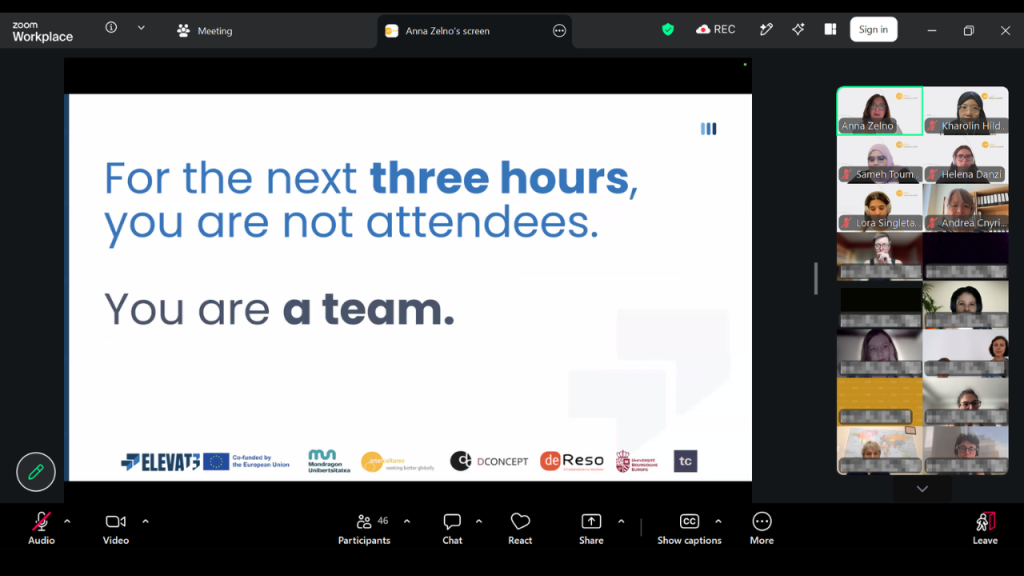
On 16 July 2026, more than 50 participants from six continents came together for the Transcultural Team Lab, an interactive online workshop hosted by intercultures España & Latam, ELEVATE’s Spanish partner, and facilitated by its CEO, Anna Zelno.
Joining from countries including France, Germany, India, Indonesia, Mauritania, Mexico, Poland, Spain, the Netherlands, Tunisia and the United States, as well as from Oceania, they brought a truly global mix of perspectives into the room. Intercultural trainers and consultants, independent and in-house facilitators, team leaders, managers, researchers and academics all arrived with different experiences and a shared curiosity: What do the live, facilitated sessions of the ELEVATE methodology look like in practice?
The ELEVATE methodology is a structured team-development approach that combines facilitated team sessions, individual reflection, digital learning and transfer activities to help teams turn diversity into sustainable collaboration practices.
Over the course of three hours, participants who had never met worked together to experience how a facilitated session within the ELEVATE methodology can transform diverse perspectives into shared solutions.
The session agenda was adapted specifically for this event to introduce selected elements of the ELEVATE Learning Journey to a broader audience and make it possible to work with a large group in an online format. The original ELEVATE learning journey includes a wider range of exercises, follows a different timeline and is designed for real teams that continue working together beyond the session
From Transcultural Competence to ELEVATE
The session opened with an introduction to the ELEVATE project and the thinking that shaped it, exploring how transcultural competence became its foundation and why today’s teams need approaches that go beyond traditional intercultural training. At the core of the methodology is a specific understanding of transcultural competence: the collective capacity of a team to consciously search for commonalities, create shared ways of working and continuously improve together. This is not about focusing on surface similarities, but about identifying shared needs and common ground that the team can build on, without setting differences aside. The team still reflects on how each member contributes through their uniqueness, and works through differences by returning to what genuinely connects them: shared needs and goals
To get a sense of who was in the room, the session opened with a short live poll on participants’ roles, their familiarity with transcultural competence, and where they were joining from. The responses reflected the range of the group: in-company and independent facilitators, team leaders and managers, employees without leadership roles, and researchers and academics, with experience spanning those entirely new to the concept and those who already knew it well.
Sameh Toumine, a member of the intercultures team, then guided the group through the ELEVATE WebApp where the digital learning journey takes place. They were introduced to features such as microlearning cards, Journals for individual and team reflection, a library of diverse resources to go back to, Team Quests for tracking shared goals, and the Chatbot, designed to support participants through guided reflection
Experiencing ELEVATE’s Four-Step Framework for Transcultural Team Competence
After the introduction, the room split into ad hoc teams of four or five people, most of whom had never met. They worked across multiple dimensions of difference, including time zones, nationalities, professions, communication styles, workplace cultures and languages. From that moment on, no one was an attendee anymore: each group was a team, working through the ELEVATE framework one step at a time and returning to the main room between activities to reflect together before moving on. Some groups even embraced the collaborative spirit of the activity with their own moments of creativity and fun along the way, a few reappearing as animal avatars.
As facilitator, Anna Zelno guided the ten teams through four connected steps in their breakout rooms. Each step built on the previous one, moving the teams from awareness (RECOGNIZE) to connection (CONNECT), co-creation (ELEVATE) and sustainable action (IMPLEMENT WITH IMPACT).
This is how the journey unfolded:
- RECOGNIZE. The starting point was to acknowledge the power of diversity and identify the team’s own patterns of collaboration. Each member shared how they could contribute to the session through their uniqueness, their background and their cultural upbringing, while the others listened and offered appreciative feedback. Looking at the team they had only just met, each group mapped its strengths, anticipated possible challenges and tried to identify emerging patterns in communication and collaboration. This was a demanding task for a newly formed team working under time pressure. Some groups managed to recognise these patterns; others found it more difficult. Their final task was to choose the one collaboration practice they believed would matter most if they were to continue working together over the next eight weeks.
- CONNECT. This step was about shared needs and common ground the team can already rely on. Around the chosen practice, teams explored what they needed from each other in relation to their chosen practice, sorting which needs were common and which were different but equally valid, and left with a shared list of both. A conversation about needs is often also a conversation about values and this is where the magic happens. People connect when they realise that they share common values, which can become a foundation for collaboration. From there, they can anchor their action plan in what matters most as they improve the chosen practice.
- ELEVATE. Here, the teams were asked to design new rituals and practices in their chosen area of collaboration, drawing on their diverse perspectives and shared needs. They first pictured themselves outstanding at their chosen practice: what people would see, what they would hear, what it would feel like day to day. They then were asked to turn those behaviours into practical, repeatable team rituals and discussed how to make them realistic within existing workloads. Not every team was able to progress at this stage, as some groups had to be merged and some participants were moved between breakout rooms, which slowed the process.
- IMPLEMENT with IMPACT. The final stage of ELEVATE, and perhaps its most powerful, is designed to support sustainable learning transfer. At this point, teams translate the rituals or new working practices they have agreed on into concrete transfer goals that can be tracked in the ELEVATE WebApp.
Participants used a prompt provided by Anna with their preferred large language model to turn each ritual into a specific and observable behaviour. The resulting goal included when and how often the behaviour would be practised, a realistic timeframe, its application beyond the workplace, its impact on the individual and others, and a simple way to reflect on progress and adjust the goal.
To illustrate the outcomes of the IMPLEMENT WITH IMPACT stage during an internal pilot, Anna and Sameh shared a use case from the extended intercultures Summer Team. During one of the ELEVATE sessions, the team developed practical rituals to strengthen its feedback culture. Once they began implementing these rituals, they realised they needed a tool that would allow them to request feedback, sometimes anonymously, and ensure that it was given in line with the quality criteria they had agreed on. In response, Sameh developed a feedback tracker with contributions from the wider team. During the webinar, the team proudly presented the tracker, while several team members shared their experiences of using it and participating in the wider ELEVATE process.
This is also a strong example of how elements of the ELEVATE process can also support onboarding. Teams can use individual sessions to focus on one specific area of collaboration they want to improve. The first two stages, RECOGNIZE and CONNECT, help the team build greater self-awareness, an essential team capability. During the ELEVATE stage, trust grows as members develop shared rituals and practices. The final stage, IMPLEMENT with IMPACT, strengthens the team’s capacity for growth, adaptation and resilience.
Learning Through Practice
The Lab demonstrated one of the core principles of ELEVATE: transcultural competence is developed through experience, dialogue, and shared reflection.
The rhythm of moving between breakout rooms and collective reflection let teams progress through the ELEVATE’s Four-Step Framework while learning from one another’s experiences.
Working in newly formed international teams, participants applied the steps to real collaborative situations, discovering how diverse perspectives can strengthen communication, build trust, and support more inclusive ways of working. Several teams reflected openly on how they had arrived at their rituals, describing how challenging each other’s ideas led to better outcomes than any of them would have reached alone.
True to the spirit of a lab, the process turned distinct elements into a solution: the uniqueness and diversity each person brought into the room were combined, step by step, into shared agreements and goals. Although the ad hoc teams would not continue working together, they left with practical ideas for rituals that could have provided a strong starting point for improving their chosen collaboration practice had they decided to continue as a team.
The mission was accomplished: the ELEVATE methodology was introduced to a global audience through an experiential format. However, experience alone does not automatically lead to learning. As there was limited time for reflection during the session, participants were invited to continue the process through a follow-up reflection survey sent by the organisers.
What Participants Said
A very convincing and practical approach. I will look into it in more detail. It was very interesting to learn about this methodology
Participants highlighted the value of the collaborative breakout sessions, describing the exchanges as enriching and expressing their interest in exploring the methodology further.
Others noted that the focus on creating lasting impact through concrete actions particularly resonated with them:
The impact part is very meaningful and dear to my heart.
Several participants also appreciated the opportunity to step outside their comfort zones and engage in meaningful dialogue with people they had only just met, reflecting the spirit of openness and learning that shaped the Lab. All participants received access to explore the ELEVATE WebApp independently.
We would like to thank everyone who joined the Transcultural Competence Lab and contributed their curiosity, openness, and insights. Bringing together participants from across the globe to experience the ELEVATE methodology together demonstrated exactly what the project seeks to foster: learning through dialogue, reflection, and meaningful collaboration across differences.