
Three Presentations, One Shared Direction
A summary of ELEVATE’s three presentations at the 6th Annual Global Forum 2026
The ELEVATE team took part in the 6th Annual Global Forum 2026 of the World Council on Intercultural and Global Competence with three connected presentations, showing how ELEVATE’s framework travels from research tool to individual practice to experiential team methodology.
1. The ELEVATE Transcultural Assessment
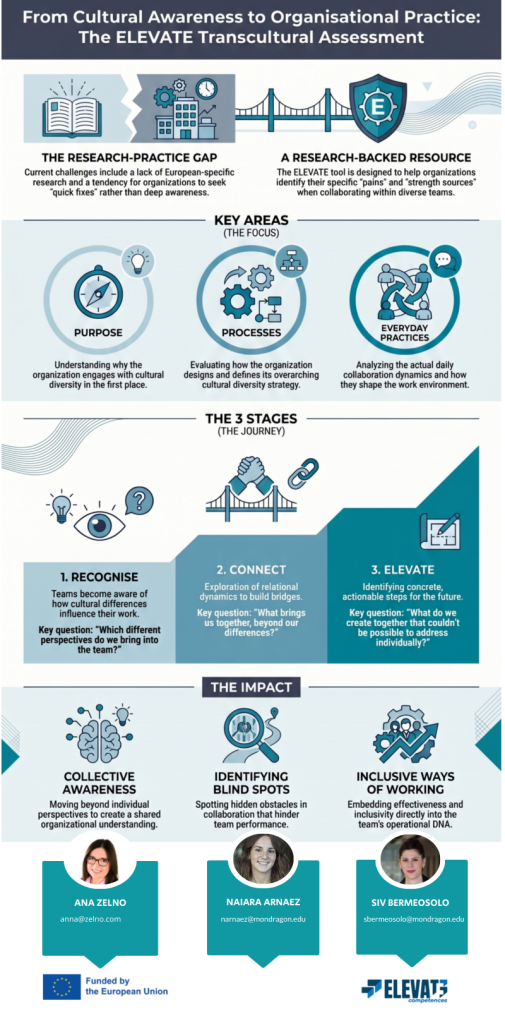
Presented by Anna Zelno, Naiara Arnaez, and Siv Bermeosolo Salterain, this poster introduced the ELEVATE Self-Assessment Tool: a structured framework helping organisations reflect on how cultural diversity is embedded, or overlooked, across their purpose, processes, and everyday practices.
The tool guides teams through three developmental stages: Recognise, becoming aware of the perspectives at play; Connect, building relational bridges across difference; and Elevate, co-creating outcomes that exceed what any individual could achieve alone.
2. A Holistic Approach to Transcultural Competence Development
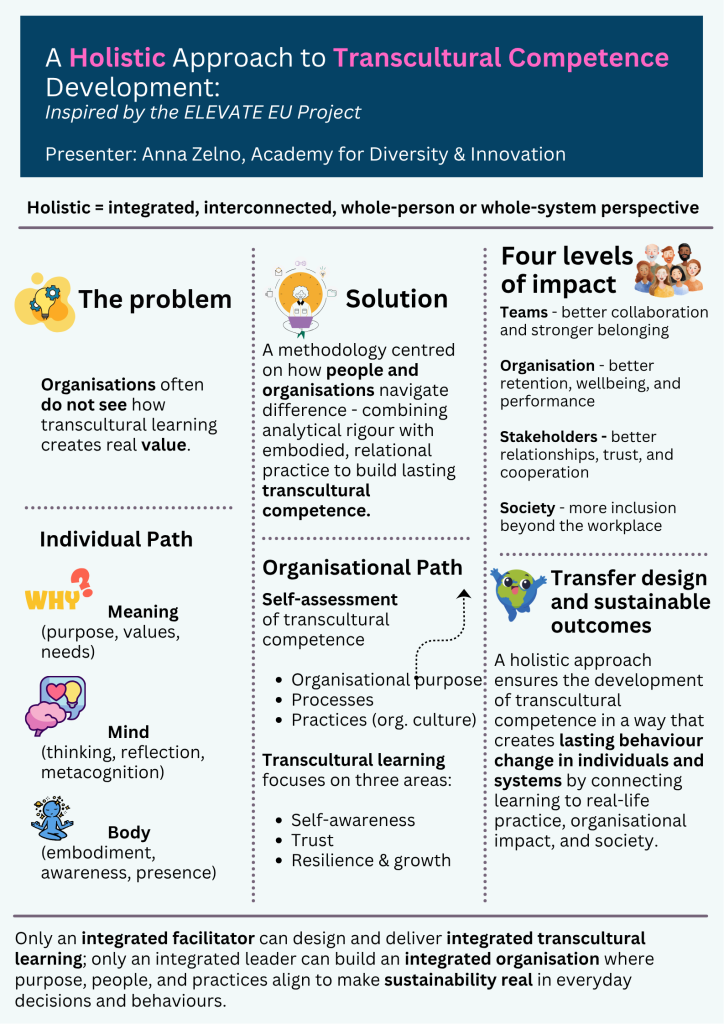
Anna Zelno extended ELEVATE’s team-level work to the individual, proposing a holistic framework connecting body, mind, and meaning as the three dimensions essential to lasting behavioural change. Drawing on transfer design and metacognitive reflection, the approach argues that only an integrated practitioner can build an integrated organisation.
The framework operates across an individual development path and an organisational path, with impact at four levels: team, organisation, stakeholders, and society.
“Only an integrated facilitator can design integrated transcultural learning, and only an integrated leader can build an integrated organisation where purpose, people, and practices align.” — Anna Zelno
3. The Team Assemblage Role-Play: A Posthuman Approach
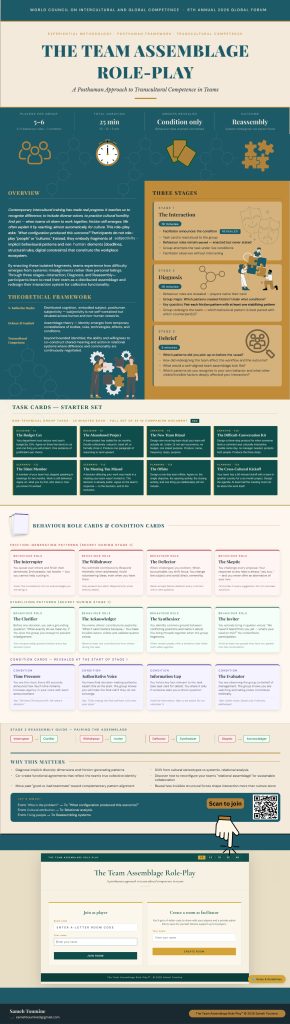
Presented by Sameh Toumine, a new member of the ELEVATE project team mentored by Anna Zelno, this experiential role-play emerged from within the ELEVATE framework, shaped significantly by the training and mentorship of Anna Zelno of intercultures España & LATAM, as a practical tool to bring its vision into the room. It invites teams to read themselves as dynamic relational systems rather than collections of fixed cultural identities and connects directly to ELEVATE’s vision of transcultural competence as something continuously negotiated through interaction rather than fixed in identity.
Participants secretly draw behavioural pattern cards and work on a task together through three stages: Interaction (friction by design), Diagnosis (revealing roles and reassembling the system), and Debrief (collective and individual reflection). The result shifts the question from “who is the problem?” to “what configuration produced this outcome?”
“To normalise dialogue, we need to normalise friction. Conflict is not final or catastrophic — it is a sign that we need to begin talking about something we have been avoiding.” — Sameh Toumine
A Shared Direction
The three presentations trace a coherent arc from the organisation (The Self-Assessment Tool) to the individual (The Holistic Approach) and the team (The Team Assemblage Role-Play). Together, they demonstrate that transcultural competence flourishes only when learning moves beyond awareness and into embodied practice across all levels.
Gathered by a refusal of surface-level fixes, these contributions argue that lasting change requires the alignment of structural, relational, and personal transformation. The Forum’s online format mirrored this theme, enabling global colleagues to engage in the very transcultural collaboration the presentations sought to define.
Acknowledgements
We would like to express our appreciation to Luciana Lallaizon for excellent moderation, to Andrea Martínez-Celis, PhD for support in the preparation, and to Darla K. Deardorff for leading the World Council community and being a true role model. Our sincere gratitude also to the whole team working behind the scenes who made this Forum possible.
Grateful for the exchanges and inspiring conversations throughout the Forum, and looking forward to bringing them back into the next chapter of ELEVATE.
For more details, read the long version of the article at [https://cutt.ly/NtC16LN2 ]